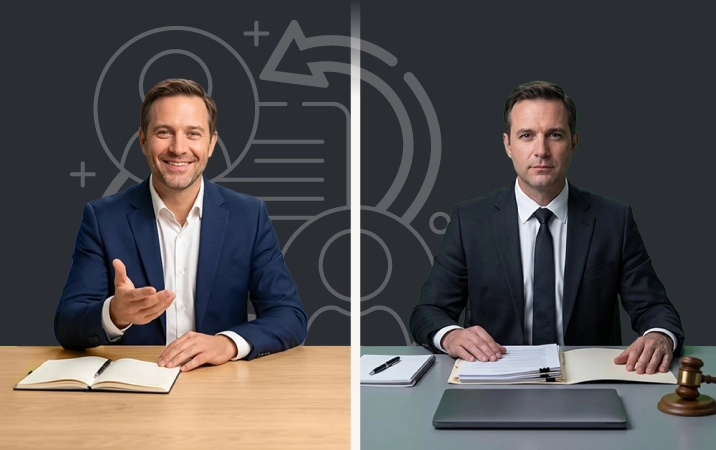

Hire a TCPA attorney when the question is legal: a demand letter, a lawsuit, a regulator’s inquiry, or an unsettled rule. A compliance consultant answers the operational question: whether consent records, do-not-call list checks and opt-out handling hold up on every call. After a claim, hire both: attorney first.
In This Article
An attorney tells you what the TCPA requires of your company and represents you when someone says you broke it. A consultant checks whether you comply. Call by call, the consultant tests your operation against those requirements and builds the controls that keep it compliant. The TCPA compliance consulting service page draws the same line: audits, script review, consent documentation and monitoring, offered alongside a qualified TCPA attorney. This post is operational guidance, not legal advice. We are not a law firm.
What does a TCPA attorney do that a compliance consultant can’t?
A TCPA attorney gives legal advice, represents you before courts and regulators, and can keep work privileged. A compliance consultant does none of these.
Representation is the visible line. A demand letter, a class action, an FCC or FTC inquiry, or a state subpoena needs someone who can appear for you. The stakes run per call. Under 47 U.S.C. § 227, the TCPA’s text, damages run to $500 per call, or up to $1,500 if willful or knowing. One claim puts the whole list in play.
Interpretation is the less visible line. The Supreme Court’s 2024 opinion in Loper Bright Enterprises v. Raimondo ended Chevron deference to agency readings of statutes. The Supreme Court’s opinion in McLaughlin Chiropractic Associates v. McKesson holds that district courts are not bound by the FCC’s reading of the TCPA. Judges now decide what the statute means. The FCC’s reading still earns respect in court, but it no longer binds the judge deciding your case. Any FCC interpretation is now contestable. The Seventh Circuit’s 2026 opinion in Steidinger v. Blackstone Medical Services holds texts are not calls under the do-not-call private right of action.
McKesson itself shows the cost. It had won summary judgment on online-fax claims because the district court treated an FCC order as binding. The Supreme Court sent those claims back. Which reading governs you is counsel’s call. Have operations record which authority each compliance decision rests on, so a new ruling traces to every affected decision.
Agency rules move as well. Day Pitney’s summary of the FCC’s September 30, 2026 order lists what changes once the rules take effect. Callers can then name one exclusive opt-out method. Whether to name one is counsel’s decision, and building and testing it falls to operations.
What does a TCPA compliance consultant actually do?
A TCPA compliance consultant tests and builds the consent, scrubbing, script and opt-out controls the rules depend on, and documents each one. The consultant’s work is operational, not legal.
The work starts from call records. A campaign compliance audit, as the service page lays it out, works through evidence like this:
- Trace a sample of dialed numbers back to a consent record, including the disclosure text the person actually saw.
- Match each dial session to the version of the national and state registries it was scrubbed against.
- Time how many business days pass between someone saying stop and every system that can call or text them knowing it.
- Listen to recordings against the approved script, and check that deviations carried a consequence in QA.
- Confirm training records for every agent.
The output is a list of gaps, each tied to the rule it touches, plus a fix the floor can implement. The consultant’s job stops at liability. A consultant cannot tell you whether a gap already makes you liable, or what to tell a plaintiff or regulator. That advice is the practice of law. The comment to the ABA’s model rule on unauthorized practice of law notes that each jurisdiction sets its own definition. Good consultants mark the handoff point.
Compliance consultant vs. TCPA attorney, side by side
A compliance consultant tests whether your operation follows the rules, while a TCPA attorney interprets them and represents you. Call the attorney first once a claim exists.
Compliance consultant | TCPA attorney | |
|---|---|---|
Question it answers | Does our operation do what the rules require, on every dial? | What do the rules require of us, and what follows if we fell short? |
Typical work | Campaign audits, consent tracing, scrub cadence, script review, agent training, monitoring | Legal opinions, demand-letter response, litigation defense, regulator inquiries, contract and registration advice |
Legal advice | No | Yes |
Represents you | No | Yes |
Privilege | None for a business-purpose audit | Attorney-client privilege and work-product protection can apply |
Output | Gap report tied to rules, remediation, process documentation, training records | Advice, filings, negotiated resolutions |
Call first when | You are auditing or launching and no claim is pending | A demand letter, complaint, lawsuit or regulator inquiry has arrived |
Most rows are either-or. The last row is a sequence, not a choice: counsel leads and operations works under counsel’s direction.
Do you need a compliance consultant or a TCPA attorney right now?
Auditing a running campaign starts with a compliance consultant, and launching a campaign or entering a new state needs both in sequence. A demand letter starts with a TCPA attorney.
You are auditing a campaign that is already running
Start with the operational side. Nobody has made a claim, and the question is whether consent, scrubbing, calling windows and opt-outs hold up in the records. Most of our audits take 5–10 business days. In our scrubbing audits, the gaps that recur are timing, missing state lists and suppression-file handling.
Bring counsel in at two points. The first is when the audit surfaces a legal question, such as whether consent wording covers texts or a B2B exemption applies. The second is a pattern of past violations. Once a claim is a realistic prospect, how the remaining work is commissioned matters, as the privilege section below explains.
You are launching a campaign or adding a state
Use both, in sequence. Counsel answers the threshold questions: registration, whether your consent language meets the strictest state, and which exemptions hold. The state-by-state mini-TCPA reference guide maps what each state adds beyond the federal rule and which states allow private suits. Bring it to that conversation. Operations then turns each answer into a dialer setting, a script line and a suppression rule.
Texas shows the split. The Business Capital case study, a one-page summary of a Texas expansion, describes the operational half of that work. It covers Chapter 302 registration under the Texas Business and Commerce Code, a $10,000 security bond, and national and Texas no-call scrubbing. SMS, 10DLC and five-year retention complete it. Each item executes a legal requirement; none decides what the requirement is or whether it applies.
Pennsylvania is the next case. Act 47 of 2026, recorded on the General Assembly’s SB 992 page as Telemarketer Registration Act amendments, takes effect October 18, 2026. Sheppard’s summary of SB 992 covers the core changes: texts count like calls, robocalls need written consent first, and seven reply words mean stop. Consent capture and opt-out parsing both change. Picture a texting program whose parser honors STOP and UNSUBSCRIBE but not QUIT, still messaging a Pennsylvanian who replied QUIT. Every later message is a new violation. Counsel reads the provisions against your program. Operations then rebuilds consent capture and opt-out keyword handling across every Pennsylvania record before the effective date.
A demand letter, complaint or lawsuit has arrived
Call counsel first, the same day. The early decisions are legal: what to preserve, what to say, whether to respond, and how to commission any investigation. The TCPA penalties and enforcement post ends with a section on what to preserve and pull in the first days after a letter. Bring that list to counsel.
Operational help comes second. Under counsel’s direction, it pulls consent records and dialer logs, sizes the affected population and fixes the process. Its speed shapes counsel’s options. A claim with a known cause and a contained population is a different negotiation from one nobody can yet size.
Need operational compliance help, not a lawyer?
If no claim is pending, a campaign compliance audit answers whether your consent records, scrubbing and opt-out handling hold up. Each gap-report finding carries its regulatory citation, so the legal questions are easy to hand to counsel.

Is a TCPA compliance audit protected by attorney-client privilege?
A business-purpose TCPA compliance audit is not privileged. Work done at counsel’s direction because a claim is expected can be protected, but courts examine why the work was done.
Federal work-product protection starts in Federal Rule of Civil Procedure 26(b)(3), which shields documents prepared in anticipation of litigation. Papers made for a coming lawsuit are protected. Papers you would have made anyway are not.
A routine annual audit is a business record, and that is the right status for most audits. Trouble starts in three ways. A business team runs the audit, counsel’s name goes on it afterward, or the report circulates widely once it lands.
The clearest example is a data-breach case. After Capital One’s 2019 breach, outside counsel directed the forensic investigation and received the report from the firm that ran it, Mandiant. A federal magistrate judge in Virginia ordered the report produced to the plaintiffs in May 2020. The district judge agreed in June. Cleary Gottlieb’s summary of the June 2020 ruling gives the court’s reasons: a pre-breach contract with Mandiant for substantially the same services. The report would have existed without the lawsuit. Capital One had also shared the report with four regulators and its accountant, for business purposes rather than litigation.
If you expect a claim, counsel decides how the investigation is commissioned, scoped and shared before anyone pulls a record. That call belongs to your attorney. Here the order of calls decides the outcome.
Does hiring a compliance consultant or calling vendor shift your TCPA liability?
Hiring a compliance consultant or calling vendor does not shift your TCPA liability for calls made on your behalf. Outside help only changes what you can prove.
The private right of action in 47 U.S.C. § 227(c)(5) covers calls made “by or on behalf of the same entity.” Your vendor’s calls count as yours. Courts use ordinary agency law to decide whether a vendor was acting for you when it called. Contract wording is only part of that test.
The Fourth Circuit’s 2019 opinion in Krakauer v. Dish Network shows that test applied to a seller that disclaimed agency on paper. Dish’s retailer, Satellite Systems Network (SSN), called numbers on the national Do-Not-Call registry during 2010 and 2011. Dish also told SSN to follow the law. The court affirmed, holding that a contractual label is not controlling, and upheld the trial court’s finding that Dish’s instructions were “empty words.” Dish knew and took no meaningful action. The jury’s $400-per-call award was trebled on a finding that the violations were willful and knowing.
$61,243,800: the judgment affirmed against Dish Network in 2019 for calls its retailer placed to numbers on the national Do-Not-Call registry
The lesson divides between the two roles. Counsel drafts the vendor contract, the indemnity and the audit rights that let you inspect the vendor’s calling. Operations, in-house or with a consultant, produces the evidence that controls ran: scrub logs, consent records, scored recordings and incident records. An indemnity clause moves money after a judgment. It does not keep you off the complaint.
Frequently asked questions
Do I need a TCPA lawyer or a compliance consultant for my outbound calling program?
Call a TCPA lawyer first if a claim, demand letter or regulator inquiry has arrived. Otherwise, start with a compliance consultant. The consultant tests whether consent records, do-not-call scrubbing and opt-out handling hold up across your calling program. Launches and new states need both.
What does a TCPA compliance consultant do that an attorney doesn't?
A compliance consultant works from call records. The work traces numbers to consent records, matches dial sessions to registry scrubs, and reviews recordings against scripts. It also times opt-outs and trains agents. An attorney interprets what the rules require; the consultant tests whether your operation actually follows them.
We got a TCPA demand letter. Should we call a lawyer or a compliance firm first?
Call a lawyer first. Preserving records, deciding how to respond and commissioning any investigation are legal decisions that affect what stays protected. A compliance consultant comes second. Under counsel’s direction, the consultant pulls consent records and dialer logs, sizes the affected population and fixes the process.
Can a telemarketing compliance consultant give legal advice?
No, a compliance consultant cannot give legal advice. Advising a company on its own legal exposure is the practice of law, which each state reserves for licensed attorneys. Each state also defines it differently. A consultant explains what the rules say and tests your operation, but cannot advise on liability or represent you.
Model it against your own volumes
The outreach compliance risk calculator takes a monthly call volume and an estimated non-compliance rate, and returns the statutory exposure under the TCPA and the TSR side by side.