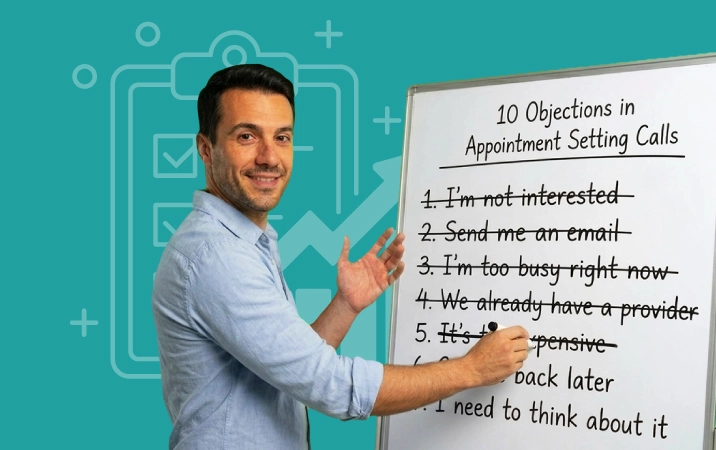


Digital lead generation channels for B2B SaaS have hit an operational saturation point. Inbound email click-through rates continue to decline while pay-per-click customer acquisition costs escalate across every primary software category. SaaS growth teams relying solely on digital channels routinely face pipeline stagnation. Executing targeted outbound calling solves this acquisition bottleneck by directly connecting business development reps with key software decision-makers.
In This Article
Why digital-only B2B SaaS lead generation hits an acquisition ceiling
Digital channels for B2B SaaS hit an acquisition ceiling because cold email open rates have declined and ad costs continue to climb across core software verticals. Outbound calling circumvents inbox fatigue by engaging decision-makers directly in live, multi-touch conversations.
Enterprise software purchasing decisions involve multi-member buying committees. Email automation tools flood decision-maker inboxes daily. Spam filters block cold sequences before human eyes see them.
Live voice outreach bypasses digital noise completely. Direct phone conversations give campaign managers immediate feedback on buying timeline, current software stack, and feature gaps. Digital attribution models mask prospect hesitation; live phone dialogues uncover exact buying objections instantly. According to RAIN Group’s sales prospecting research, direct phone calls remain one of the most effective strategies for securing meetings with executive buyers.
Recent research from the Content Marketing Institute B2B benchmark study highlights that over-reliance on purely automated digital channels leads to rising acquisition costs and diminishing pipeline returns. Combining voice with digital touchpoints creates a multi-channel moat that protects campaign yield.
Navigating TCPA and TSR boundaries in B2B software outreach
Executing outbound voice campaigns for SaaS requires strict adherence to TCPA and TSR guidelines, including real-time Do Not Call scrubbing and verified consent logging. Compliance frameworks protect growth teams from statutory penalties while maintaining high dial velocity.
Scaling b2b saas lead generation requires strict adherence to regulatory boundaries. Combining automated dialers with enterprise software databases introduces significant regulatory risk under federal law.
CHANNEL EXECUTION VARIABLE | DIGITAL-ONLY OUTREACH | OUTBOUND PHONE OUTREACH |
|---|---|---|
Primary Contact Method | Primary Contact Method Automated Email Sequences | Direct Dial Voice Calls |
Response Horizon | 24–72 Hours (If Opened) | Instantaneous Real-Time Feedback |
Regulatory Framework | CAN-SPAM Act | TCPA, TSR, DNC Scrubbing |
Objection Discovery | Inferred via Unsubscribes | Direct Qualitative Capture |
Navigating telephone outreach mandates rigorous protocol execution. Maintaining strict TCPA compliance consulting oversight protects brands from statutory penalties while scaling outbound volume. The FCC TCPA guidelines mandate strict adherence to opt-out rules, time-of-day restrictions, and automated dialing parameters across all state jurisdictions.
Integrating phone outreach into modern CRM and sales automation stacks
Phone outreach integrates into modern CRM stacks by converting live call disposition metrics directly into automated follow-up workflows and sales-qualified leads. Direct CRM sync ensures BDRs receive instantaneous context for higher meeting conversion rates.
Outbound calling cannot exist in an operational silo. Lead data must flow directly into active sales pipelines. Standardized qualification frameworks ensure phone agents transfer only sales-ready software opportunities to internal closers.
Raw Prospect List ──> Real-Time DNC Scrub ──> Live Voice Outreach ──> Qualification ──> Direct CRM Injection
Integrating phone outreach into multi-touch campaigns amplifies overall conversion metrics. Software buyers who receive a voice follow-up within 10 minutes of downloading marketing collateral convert to qualified pipeline at significantly higher rates than those receiving automated email nurture tracks.
Evaluating key performance indicators and cost benchmarks for SaaS outbound
SaaS outbound calling performance is measured through metrics like connect rate, cost per qualified appointment, and pipeline velocity. Standard B2B campaigns achieve qualified appointment costs ranging from $170 to $264 depending on target ICP complexity.
Evaluating campaign return on investment requires tracking unit economics across the entire qualification funnel.:
• Connect Rate: The percentage of dials that result in a live conversation with a targeted decision-maker (typically 3%–8% on cold B2B data).
• Conversion to Meeting: The ratio of live connects that agree to an initial discovery demo or sales appointment (benchmarked at 8%–15%).
• Cost Per Qualified Appointment (CPA): Confirmed benchmark range is $170–$264 per qualified appointment for mid-market SaaS campaigns.
Understanding these metrics allows growth managers to accurately model pipeline output based on initial dialing volume.
Evaluate your SaaS outbound legal risk profile
Outbound calling carries severe legal risks if executed without verified consent protocols, proper scrubbing infrastructure, and trained agent oversight.

In-house BDRs versus outsourced lead generation partners
Building an internal BDR team incurs heavy recruitment, management overhead, and 60-to-90-day ramp timelines, whereas an outsourced partner provides pre-trained agents and immediate infrastructure. Outsourcing reduces fully loaded BDR costs while maintaining consistent dial volume.
Building an internal business development representative team requires heavy operational overhead, long ramp timelines, and ongoing management churn. Fully loaded in-house BDR costs range from $85,000 to $130,000 annually per rep before producing a single qualified meeting.
Modern software firms utilize specialized outbound execution models to scale calling volume rapidly without adding fixed headcount costs. For a complete analysis on selecting the right execution model, read our guide on evaluating B2B lead generation providers.
Frequently asked questions
How does outbound calling complement digital lead generation for B2B SaaS?
Outbound calling complements digital SaaS lead generation by converting cold prospects who ignore email sequences and paid ads into a qualified pipeline. Live phone conversations allow agents to identify immediate software pain points, address objections, and qualify buying committee members in real time.
What is a realistic cost per qualified appointment for B2B SaaS lead generation?
A realistic cost per qualified appointment for B2B SaaS ranges between $170 and $264 for specialized B2B campaigns. Total cost depends on deal size, ICP tightness, buyer seniority, and qualification complexity.
How do B2B SaaS outbound campaigns remain compliant with the TCPA?
B2B SaaS outbound campaigns ensure TCPA compliance by executing real-time National Do Not Call registry scrubbing, maintaining express consent audit trails, and enforcing automated agent script adherence. Utilizing compliance monitoring software prevents regulatory exposure on high-volume dials.
What is the typical timeline to launch an outsourced SaaS lead generation campaign?
An outsourced SaaS outbound campaign typically launches within 5 to 7 business days from kickoff. This timeframe covers ICP scoping, list sourcing and data hygiene, script engineering, CRM integration, and agent training.
Calculate your outbound compliance risk profile
Outbound calling carries severe legal risks if executed without verified consent protocols, proper scrubbing infrastructure, and trained agent oversight.