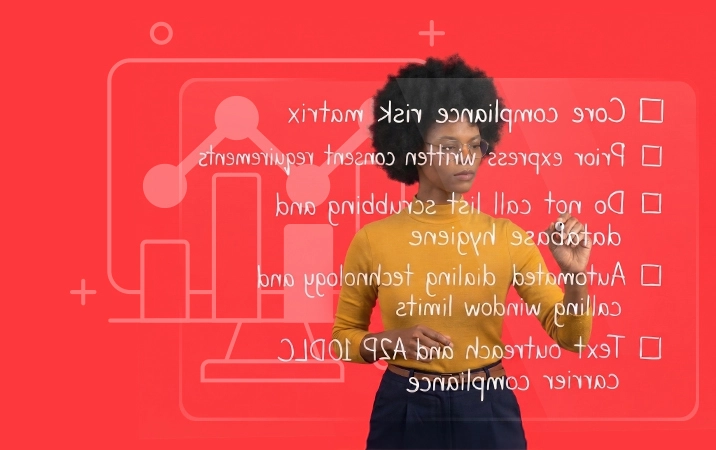


The Telemarketing Sales Rule (TSR) is a federal regulation, codified at 16 CFR Part 310 and enforced by the Federal Trade Commission, that governs how businesses sell goods and services over the phone. It is designed to protect consumers from deceptive and abusive telemarketing practices through required disclosures, a ban on material misrepresentations, restricted calling hours, Do Not Call obligations, and a five-year recordkeeping requirement.
In This Article
If you run an outbound program, most of your compliance knowledge is probably TCPA knowledge. Reasonable: the TCPA is where the private lawsuits are. The TSR tends to arrive later, often the first time an audit maps your operation against it line by line, or a client’s due diligence questionnaire asks for proof; the campaign compliance audit service page breaks down what one covers and what it asks of your team. The rule works differently enough that TCPA knowledge does not transfer: different agency, different obligations, different assumptions about what a B2B operation can safely ignore.
What is the Telemarketing Sales Rule designed to do?
The Telemarketing Sales Rule is designed to protect consumers against deceptive and abusive telemarketing acts and practices. It does that by requiring specific oral disclosures on sales calls, prohibiting material misrepresentations, restricting when telemarketers may call, and giving people enforceable ways to stop unwanted calls.
It is easy to confuse the TSR with the TCPA, because both regulate the same calls. The FCC enforces the TCPA, which governs the technology (autodialers, prerecorded messages, texts, and the consent each requires). The FTC enforces the TSR, which governs the conduct of the sale (disclosures, claims, calling hours, records). A campaign has to clear both, and clearing one tells you almost nothing about the other.
The complete current text lives at 16 CFR Part 310 on eCFR: every section from definitions through exemptions, with each section’s amendment history listed at its foot. It is shorter and more readable than most federal regulations, and worth bookmarking as the version to check any compliance claim against, including ours.
What does the FTC Telemarketing Sales Rule require? A summary
In summary, the FTC Telemarketing Sales Rule requires telemarketers to say who they are and what they are selling, tell the truth about price and terms, honor Do Not Call rights, call only between 8 a.m. and 9 p.m. local time, and keep records for five years.
Requirement | Where it lives | What it means in practice |
|---|---|---|
Oral disclosures | 16 CFR § 310.4(d) | Before the pitch, the agent identifies the seller, states that the purpose of the call is to sell, and names what is being sold. |
Do Not Call | 16 CFR § 310.4(b) | Scrub against the National DNC Registry at least every 31 days, and honor entity-specific (internal) opt-outs indefinitely. |
Calling hours | 16 CFR § 310.5 | Calls only between 8 a.m. and 9 p.m. local time at the called person’s location, which the dialer must calculate, not the agent. |
Recordkeeping | Direct U.S. statutory adherence | Five years for most records: call detail records, consent documentation, scripts, advertising, and employee records. |
Payment restrictions | 16 CFR § 310.4(a) | Advance-fee bans for specific categories: credit repair, debt relief, and recovery services get paid on results, not upfront. |
The weight is in the third column: each row is something that must happen on every one of thousands of calls a week.
Does the TSR apply to B2B calls? Where the exemption begins and ends
Mostly no, with one significant exception. The TSR’s business-to-business exemption at 16 CFR § 310.6(b)(7) removes most of the rule’s obligations for calls between a telemarketer and a business. But since the FTC’s 2024 amendments, the rule’s prohibitions on false and misleading statements apply to B2B calls in full.
B2B calling has been largely exempt since 1995. In 2024 the FTC extended the misrepresentation bans to all B2B telemarketing and explicitly declined to go further; the final rule as published carries the full record (effective dates, the comment-by-comment discussion, and the agency’s explanation of why it stopped at misrepresentations), which makes it the document to hand counsel if scope questions ever come up. A genuine B2B campaign is still not obligated to scrub against the National DNC Registry under the TSR, and most disclosure and recordkeeping mandates still do not attach. What changed: every claim an agent makes about price, capability, delivery, or affiliation is now federally actionable, exactly as on a consumer call. § 310.6 itself is a short list of every call type the rule does not reach, with the B2B carve-outs spelled out in its provisos; read it in the original, because the boundaries matter more than any summary of them, including this one.
Two boundaries deserve respect. “B2B” is defined by who you are calling and why, not by how your company positions itself: campaigns that reach sole proprietors on personal numbers, or upsell consumer products to business contacts, drift out of the exemption without anyone deciding to leave it. And the TCPA has no B2B exemption for its consent rules, so wireless numbers on a B2B list still need scrubbing and consent handling. Teams running outsourced B2B lead generation should hold their scripts to the misrepresentation standard exactly as a consumer team would; if you are weighing in-house against a partner, the outsourced B2B lead generation page describes what a partnered program involves and what it requires from the client side.
What does complying with the Telemarketing Sales Rule involve day to day?
Complying with the Telemarketing Sales Rule means building its requirements into the dialing infrastructure itself: automated DNC scrubbing on at least a 31-day cycle, time-zone locks calculated from the called number’s location, scripts with the required disclosures built in, and archiving that captures every call record for five years.
The rule is written as a list of prohibitions; an operation experiences it as a systems problem. At volume, “agents are trained on the calling window” is not a control. A dialer that mathematically cannot place a call outside 8 a.m. to 9 p.m. at the destination is one. The same logic runs through the rest of the rule:
- Scrub cadence. Thirty-one days is the ceiling, not the target; lists decay daily as numbers join the registry.
- Consent records are mechanism-specific. A digital opt-in needs the timestamp, the IP, and the exact disclosure text shown; a verbal opt-in needs the recording itself, retrievable on request. In consent-critical programs we have seen agents required to read the disclosure word for word, with any deviation an automatic quality failure.
- Opt-outs have to travel. A “stop” captured in one channel has to propagate to every active list, voice and SMS alike; siloed suppression lists are how a company honors an opt-out and violates it in the same week.
- State law stacks on top. Multi-state campaigns also answer to state mini-TCPA statutes, and the strictest applicable law wins.
The reason to build this before the first dial is the TSR’s own escape hatch. Safe harbor forgives isolated errors, but only for operations that can show written procedures, trained personnel, active monitoring, an honored internal Do Not Call list, and documented 31-day registry access. It was either built in advance or it does not exist. That is the treasure guarded by the administrative tedium: the ability to make an honest mistake at volume and survive it.
See where your campaign actually stands
The fastest way to know whether your dialer configuration, scripts, and records would hold up under the TSR is to map them against it, requirement by requirement. That is what a campaign compliance audit is for.

Which industries face special TSR rules? Credit repair and debt relief
The TSR imposes advance-fee bans on specific service categories: credit repair, debt relief, and loan or lost-money recovery services. Sellers in these categories cannot collect payment until the promised result has actually been delivered. For credit repair, no payment until the represented timeframe has passed and the promised improvement is documented with a consumer report issued at least six months after the results were achieved. For debt relief, no fee until a settlement is reached with at least one creditor and the consumer has made a payment under it. The pattern is the lesson: the FTC regulates payment timing hardest where the abuse history is worst, so if your clients include these verticals, script and billing review is a launch prerequisite, not an afterthought.
The failure mode here is billing rhythm rather than intent: a debt relief program that invoices at enrollment instead of at settlement violates the advance-fee ban on every sale it closes. § 310.4(a) lists each restricted category and states the exact conditions that must be met before a fee can be collected; read it in full before touching these verticals, because compliance turns on that precise wording.
What are violations of the Telemarketing Sales Rule regarded as?
Any violation of the Telemarketing Sales Rule is regarded as an unfair or deceptive act or practice under Section 5 of the FTC Act. That classification is what gives the FTC authority to seek civil penalties, currently up to $53,088 per violation, along with injunctions and consumer redress, and it lets state attorneys general bring actions as well.
Because penalties are assessed per call, exposure scales with volume, which is why the controls above live in the dialer rather than in a training memo. What enforcement looks like in practice (which violations the FTC actually pursues, and what recent cases have cost the companies involved) is covered in our companion piece on penalties and enforcement.
None of this requires fear to take seriously; it requires a decision about where compliance lives. Built into the infrastructure, the TSR is a set of configurations. Left to memory and memos, it is a set of liabilities that grows with every list you load.
Frequently asked questions
What is the Telemarketing Sales Rule in simple terms?
The Telemarketing Sales Rule is a federal regulation, enforced by the FTC and codified at 16 CFR Part 310, that requires telemarketers to identify themselves, tell the truth about what they are selling, honor Do Not Call requests, call only between 8 a.m. and 9 p.m. local time, and keep records of their calls for five years.
Any violations of the Telemarketing Sales Rule are regarded as what?
Violations of the Telemarketing Sales Rule are regarded as unfair or deceptive acts or practices in violation of Section 5 of the FTC Act. That classification allows the FTC and state attorneys general to seek civil penalties of up to $53,088 per violation, injunctions, and consumer redress.
Does the Telemarketing Sales Rule apply to B2B calls?
Mostly no. The exemption at 16 CFR § 310.6(b)(7) removes most TSR obligations for business-to-business calls, but since the FTC’s 2024 amendments the rule’s bans on false or misleading statements apply fully to B2B telemarketing. Separately, the TCPA’s consent rules contain no B2B exemption, so wireless numbers on B2B lists still require scrubbing and consent handling.
Who enforces the Telemarketing Sales Rule, the FTC or the FCC?
The FTC enforces the Telemarketing Sales Rule. The FCC enforces the TCPA. The two rules overlap on the same calls: the TCPA governs calling technology and consent, while the TSR governs sales conduct, disclosures, calling hours, and recordkeeping.
How long do telemarketing records have to be kept under the TSR?
Five years for most records, under the FTC’s 2024 amendments, up from the previous 24 months. Covered records include call detail records, consent documentation, scripts, advertising materials, and certain employee records.
What hours can telemarketers call under the TSR?
Telemarketers may call only between 8 a.m. and 9 p.m. local time at the called person’s location. The obligation follows the recipient’s time zone, not the caller’s, so dialing systems must calculate local time from the number being dialed.
Launching or scaling outbound this year?
If outbound is on your roadmap and compliance is the part you would rather not build alone, a short conversation is usually enough to figure out whether there is a fit.