
B2B appointment setting scripts get a yes by asking for an appointment set, meaning a decision-maker accepts a time with your salesperson. The product pitch waits until then. The caller gives their name and a true reason for calling, asks one question about the prospect’s business, then offers two specific times.
In This Article
Appointment setting scripts break in two places. The opener sounds like every other cold call, so the decision-maker ends it before the reason arrives. Or the setter keeps describing the product until the decision-maker asks for an email instead of a time.
Both failures have a fix. The B2B appointment setting service page shows how one provider builds scripts from your value proposition and messaging. That provider’s setters rehearse each script in role-play, and weak scripts get revised the same day.
What does a B2B appointment setting script have to do?
A B2B appointment setting script has one job: turn a conversation with a decision-maker into an appointment set on your closer’s calendar. It sells the next conversation, never the product.
Start with two funnel terms. An appointment set is a decision-maker who has accepted a specific date and time with your closer, the salesperson who runs it. An appointment held is an appointment set that took place with the decision-maker on the call.
A script fixes some lines word for word. The fixed lines are the ones where a mistake costs the most: identity, reason, the ask, qualification questions and the do-not-call response. Everything between them is a talk track: the setter’s own words, steered by the script but never read aloud.
Part | What tFixed or talk trackhe setter does | What it does | How it fails |
|---|---|---|---|
Identity | Fixed | Names the setter and the company the call is for | A vague name such as “the partnerships team” sounds like a pretext |
Reason for the call | Fixed | Says in one sentence why this company, now | A fake follow-up such as “returning your call” starts the appointment in distrust |
Relevance | Talk track | Ties the reason to the prospect’s own situation, in their words | Turns into a product walkthrough |
The ask | Fixed | Asks for a set length of time with a named closer, at two specific times | “Would you be open to a call sometime?” invites “send me something” |
Qualification questions | Fixed | Confirm each criterion in your standard and record the answer | Skipped, they send closers appointments that never fit |
Do-not-call response | Fixed | Confirms the request, logs it and ends the call | A rebuttal before the request is honored |
On an outsourced program, scripting comes early. The outsourced appointment setting service page lists it third of six program steps, after scoping and setup and before setter training.
The guide to what B2B appointment setting is and how it works lists six techniques, including leading with the reason and offering two times. Five of them become lines below. The full call path is mapped step by step in the outbound appointment setting process from cold call to appointment set.
How does a setter get past the gatekeeper without misleading anyone?
A gatekeeper protects the decision-maker’s time, so the script gives a truthful reason to put the call through or name a better time. A pretext buys one transfer and costs trust.
Ask for the decision-maker by role or name. Give the gatekeeper the same one-sentence reason the decision-maker will hear, and ask when to call back if now is wrong. Lines like “she’s expecting my call” get relayed. A decision-maker who learns the call was cold then starts the whole conversation already guarded.
Define what an appointment set means for your team
A strategy call maps your ideal customer profile, your qualification criteria and how many appointments your closers have room for each month. Bring your current numbers.

Template 1: the gatekeeper
Setter
Good morning, this is [your first name] calling for [company the call is for]. I'm trying to reach the person who handles [area, such as equipment financing]. Is that [decision-maker's name or title]?
If asked what it's about
We work with [type of company] on [problem, in one line], and I'd like to ask [name] for twenty minutes with [closer's name], our [closer's title]. Is now a good time to put me through, or when is better?
If asked to send something
Glad to. Which address should I use, and what's the best day to follow up with [name] directly?
If the decision-maker is out
What time of day is best to reach [name]? I'll call back then.
- Ask by role when names are missing. A role tells the gatekeeper whose time you need, which a generic “the owner” does not.
- Give one reason, not two. The gatekeeper passes the message along, and a second version of the reason surfaces the moment they do.
- Log the gatekeeper’s name and the callback time. The next attempt opens with “Maria said Thursday mornings work,” and the call starts where the last one ended.
What should a B2B appointment setting script say in the first 30 seconds?
In the first 30 seconds, a B2B appointment setting script names the setter and the company, gives the reason and asks one question. The product description waits for the closer.
Identity comes first, in one line. When a provider calls for you, the setter says they are calling on behalf of your company, which keeps the identity true.
The reason for the call is one true sentence about why this company, now: a new location, a hiring push, a rule change. Your list or research supplies it. A reason the setter can’t explain under one follow-up question doesn’t belong in the script.
Then the setter asks a question the decision-maker can answer about their own operation, and listens to the answer. The ask waits for a connection. Once the answer touches the problem your closer solves, the ask names the time, the person and two slots.
Template 2: the decision-maker, from opener to ask
Setter
Hi [first name], this is [your first name] calling on behalf of [company]. We help [type of company] [outcome, in one line], and I'm calling because [true, specific reason this company fits]. How are you handling [problem] today?
Talk track
[Two or three questions about their answer, in the setter's own words. No product walkthrough.]
The ask
That's the problem [closer's name], our [closer's title], works through with teams like yours. Would twenty minutes on [day] at [time] or [day] at [time] work to see whether it fits?
If asked not to be called again
Understood. I'm taking you off our list now. Thank you for your time. [End the call and log the request before the next dial.]
The compliance layer under these lines is set out line by line in the guide to keeping telemarketing scripts TCPA-compliant. It covers identification wording and the do-not-call response.
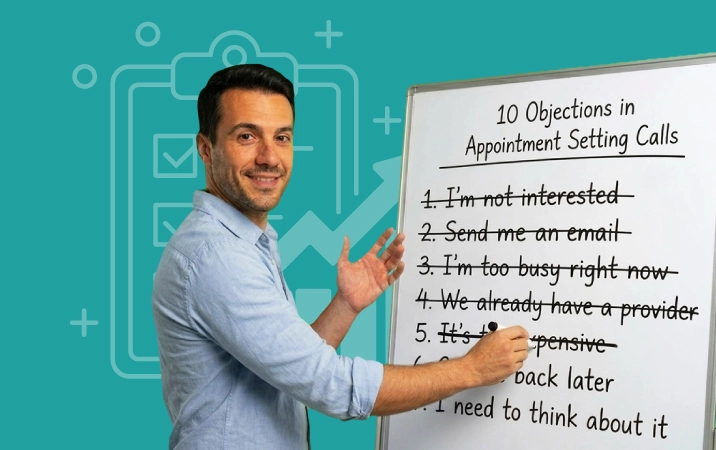
An ask can come back as a condition: send me something, or call next quarter. Each condition has a scripted reply in the guide to the top 10 objections in appointment setting calls.
A yes gets the close. The close confirms the time, then asks the questions your qualification standard requires, so the closer walks in with answers. Writing that standard is the subject of defining qualification criteria for your appointment setting campaign.
Template 3: the set and capture close
What the setter says | What it captures | Criterion it confirms |
|---|---|---|
[Day] at [time] Eastern with [closer’s name], then. Who else should be on the call? | Attendees and their roles | Decision-maker title |
What would make the twenty minutes worth your time? | The open question the closer has to answer | Confirmed need |
Who besides you signs off on spending for something like this? | Who controls the budget | Budget authority |
When would you want something in place? | The buying window | Timeline |
You’ll have the invite from [closer’s name] by [time], and we’ll confirm by phone and email within a day. | The confirmation commitment | None; it protects the appointment held |
What should the follow-up call say after a decision-maker asks for information?
A follow-up call after an information request opens by naming what was sent and when, then asks one question about it. A clear yes gets two specific times.
An information request makes a soft lead: a decision-maker who wants information before agreeing to a time. That request is pipeline, not a lost call. The comparison of appointment setting and lead generation explains how soft leads enter a nurture queue and get counted apart from appointments set. Reporting that counts soft leads beside appointments set keeps that pipeline visible to your marketing team.
Set up the follow-up on the first call. “I’ll send the one-page summary today and call Thursday” gives the second call its opening line. The setter logs both the material sent and the promised call date on the contact record.
Template 2: the decision-maker, from opener to ask
Setter
Hi [first name], it's [your first name] with [company]. On [day] you asked me to send [what was sent], and it went out that afternoon. Did it answer what you were weighing?
If yes
What stood out? [Listen.] [Closer's name] can walk through how that applies to [their company] in twenty minutes. Does [day] at [time] or [day] at [time] work better?
If not read yet
The short version: [one sentence]. Is that worth twenty minutes with [closer's name] on [day] or [day]?
If not now
Understood. When does it make sense to revisit this? I'll note that date and won't call before it. [Log a soft lead with the revisit date.]
Voicemail is the other half of the follow-up. Its length and callback rules are covered in voicemail scripts that get callbacks from B2B prospects.
How do you test a sales call script for appointment setting?
Test a sales call script for appointment setting on one number: appointments set per conversation with a decision-maker. Change one line at a time.
Count per conversation, not per dial. Dials measure the list and the connect rate, while conversations with decision-makers measure the script itself. Read the result next to show rate, the share of appointments set that become appointments held. A gain can hide a loss. A line that raises appointments set while show rate falls moves the problem onto your closers’ calendars.
Record the script version on every call disposition. Each number then traces back to the exact lines that produced it, which turns a hunch into a test. Then listen to where conversations end: after the identity line, after the reason or after the ask. Each spot points to one line.
Pace matters as much as method. The appointment setting service page commits to revising a script the same day it stops working and adjusting talk tracks daily. Even a daily cycle changes one line per revision, or the next day’s number can’t be traced to a line.
What does a script change do to cost per held appointment?
Cost per held appointment is the program’s total cost divided by the appointments that actually took place. A script change lowers it when it raises appointments held for the same spend, not just appointments set.
One provider publishes its numbers. Its appointment setting service page reports healthcare programs on 160-hour phone calling blocks setting 20 to 30 appointments each. That is $176 to $264 per appointment set. The same page reports a 70% to 85% show rate across its client programs, not healthcare alone. Those appointments pass four checks, on title, budget authority, timeline and need, and get confirmed within 24 hours. Divide price by show rate. Applied to the healthcare price, the all-client show rate gives a cost per held appointment of $207 to $377. Deal size and list source for that case are not published, so treat it as one data point.
Then run your own numbers. Take your program’s total cost, divide by appointments held, and compare script versions on that figure. Price every provider the same way.
Can an AI voice agent run the same script?
An AI voice agent can’t cold-call mobile numbers. The FCC’s declaratory ruling on AI-generated voices, FCC 24-17, holds that AI-generated voices count as artificial voices under the Telephone Consumer Protection Act.
The agency’s rule text at 47 CFR 64.1200 requires prior express written consent for a telemarketing call to a mobile with an artificial voice. Mobiles carry no business exception. Put simply: same words, different consent rule. The rule covers a decision-maker’s mobile direct dial too, and the consent must be a signed agreement naming your company and the number. Business landlines fall outside that consent rule, yet every artificial-voice message must open with the business’s registered name and give a callback number.
A cold list has no such consent. Direct dials can mix landlines and mobiles, and only a wireless scrub tells them apart, so cold openers stay human.
National Mortgage News’ report on the Mortgage One Funding lawsuit describes a February 2026 class action alleging AI-voiced telemarketing calls to cellphones without consent. The report covers allegations, not a ruling. A B2B list of mobile direct dials carries the same exposure, because the rule follows the number, not the buyer.
Keep cold openers with live setters. Use an AI voice only on numbers whose written consent names your company, after a wireless scrub of every list. Script its first line as your registered business name, then give a callback number on every call. Test the automated opt-out before launch. Recorded clips played during a live call raise the same question, so they get the same review.
The rule itself is moving. Since the Supreme Court’s 2025 McLaughlin ruling, federal judges read the statute themselves instead of deferring to the FCC. The Fifth Circuit’s February 2026 Bradford ruling, binding in Texas, Louisiana and Mississippi, reads it to require only prior express consent, oral or written. Written consent clears every court either way.
The FCC’s 2024 proposal on AI-generated calls would add a disclosure at the start of each one, still unadopted in October 2026.
This is operational guidance, not legal advice.
Which parts of a sales appointment setting script does your team supply?
Your team supplies the facts a sales appointment setting script cannot invent: the value proposition, the qualification standard, open slots and approved claims. A provider writes the lines around them.
Those inputs carry the risk. A provider can write clear lines around a claim, but it cannot know whether your legal team will defend it. Sign off the fixed lines in writing before the first dial, and treat every later change as a new version.
Sign-off is one of four decisions you keep. The guide to the outbound appointment setting process names all four: the qualification standard, script sign-off, calendar slots and each appointment’s outcome.
Evaluation works the same in-house or outsourced. Put these four questions to any provider writing your scripts, including us, or to your own sales development team:
- Who approves a change to a fixed line? The answer names a person on your side and puts the turnaround time in writing.
- How is the script version recorded? Every call disposition should carry it, so each test result traces back to specific lines.
- Whose company does the setter name first? The identity line is yours to approve, word for word, before any call goes out.
- Will any call use an AI voice? If yes, ask which numbers it will dial and what written consent covers each one.
When does scalable B2B appointment setting make sense for your team?
Scalable B2B appointment setting needs a defined ideal customer profile and closers with open calendar time. Without both, more appointments add cost, not revenue.
Volume scales in blocks of calling hours. Recurring enterprise programs of 800 hours or more push the cost of each appointment set lower than a single block does.
Volume also multiplies information requests, and each one is a lead to work rather than an appointment to keep. Who works them is its own decision. The split between appointment setting and lead generation sets out both services and the numbers each one answers to.
Scale works in both directions. Adding setters to a loose profile burns through the list faster and books appointments your closers cancel. With the profile and criteria right, the same campaign grows from one pilot block to a full program without changing shape.
Frequently asked questions
What should a B2B appointment setting script say in the first 30 seconds of a cold call to a decision-maker?
A B2B appointment setting script uses its first 30 seconds for three things: the setter’s name and company, a specific reason and one question. The product walkthrough belongs to the closer. The opening ends with a question the decision-maker can answer about their own business, never with a pitch.
How does an appointment setter get past a gatekeeper without misleading anyone about why they're calling?
To get past a gatekeeper, ask for the decision-maker by role or name and give the same one-sentence reason the decision-maker will hear. Never imply a referral or an earlier conversation. If now is wrong, ask for a better time and log the gatekeeper’s name with it.
Should our appointment setters read the script word for word, or work from a talk track?
Appointment setters should read some lines word for word and work from a talk track for the rest. Five parts are fixed word for word. They are the identity line, the reason for the call, the ask, the qualification questions and the do-not-call response. Everything between them is a talk track: the setter’s own words, steered by the script.
What should the follow-up call say when a decision-maker asked us to send information first?
Can an AI voice agent run our appointment setting script on cold calls to decision-makers?
An AI voice agent can’t cold-call mobile numbers. The FCC treats AI-generated voices as artificial voices under the Telephone Consumer Protection Act, so the robocall consent rules apply. A telemarketing call to a mobile with an artificial voice needs prior express written consent, and business mobiles get no exception. Cold openers stay with live setters.
Bring your current script to a strategy call
A strategy call walks through your opener, your ask and the lines your team signs off, against your qualification standard. Bring a recorded call if you have one.