
B2B appointment setting is outbound calling that books first sales appointments between your closers and decision-makers who fit your target profile. An appointment setter calls a targeted list, qualifies each prospect against your criteria, and puts the appointment on the closer’s calendar with notes attached. Closers spend their time selling, not dialing.
In This Article
The problem shows up on the calendar first. When account executives prospect their own pipeline, dials and follow-up crowd out the discovery calls they are paid to run.
Strong selling weeks starve next month’s pipeline, and slow weeks leave closers with open afternoons and nothing booked. Appointment setting splits those two jobs.
The B2B appointment setting services page lists how a campaign gets built, from scoping to launch and optimization. Whether to staff it in-house or outsource it is a cost question with a clear formula.
What is B2B appointment setting?
B2B appointment setting is prospecting for one output. Its product is an appointment held: a scheduled time with your closer that a qualified decision-maker actually keeps.
Appointment setting for B2B runs on five funnel terms, and a report that blurs them hides where prospects drop out. Each term names one stage.
- Lead: a contact at a company that fits your profile, with no confirmed interest yet.
- MQL (marketing-qualified lead): a lead who has shown interest through a marketing action, such as downloading a guide. Interest is not intent.
- SQL (sales-qualified lead): a lead confirmed on a live call to have a need, a budget, authority to buy and a timeline.
- Appointment set: an SQL who has accepted a specific date and time with your closer. It counts once the invite is accepted.
- Appointment held: an appointment set that takes place, with the qualified person on the call.
A demo is a later step: the product walkthrough a closer runs once an opportunity exists. Appointment setting stops before it.
Lead generation stops at the SQL, while appointment setting carries the same contact through to an appointment set. Both outputs come from the same dials. A prospect who asks for information instead of an appointment goes to a nurture queue, not the trash. Those leads feed your marketing team’s nurture program, not a closer’s calendar, until they ask for an appointment.
Volume is the hidden cost. Connect rate is the share of outbound dials that reach a live person who matches your target profile. On outbound B2B phone campaigns dialing corporate main lines, it runs 11% to 13% of dials. That is eight or nine dials per conversation. The B2B lead generation primer breaks connect rates down further by target type, from gatekept switchboards to direct lines.
How does B2B appointment setting work, step by step?
A B2B appointment setting campaign runs in six stages: target, script, connect, dial and qualify, set, and confirm. Your team supplies one input at each stage.
Stage | What the setter does | What your team supplies |
|---|---|---|
1. Target | Builds or audits the call list against your ideal customer profile | The profile: industries, company size, titles, territory |
2. Script | Writes the talk track and the qualification checklist | Your value proposition and the criteria an SQL has to meet |
3. Connect | Links your CRM and calendar so appointments land with notes | Calendar access and the CRM fields you want filled |
4. Dial and qualify | Calls, leaves voicemails, follows up and checks criteria live | Feedback on the first appointments held |
5. Set | Schedules the appointment with a pre-appointment brief for the closer | Open calendar slots |
6. Confirm | Calls and emails within 24 hours of the appointment set | A held or no-show result for every appointment set |
The campaign walkthrough on the B2B appointment setting service page shows how a program is built and run, including dialing modes and daily reporting. Setup takes five to seven business days. That window covers list build, scripting, setter training, dialer setup and CRM integration before the first dial. First appointments get set within 48 to 72 hours after the campaign goes live on the phones.
List quality caps every number downstream. The ideal customer profile guide for outbound campaigns walks through the firmographic, technographic and financial filters to set before the first dial.
Who makes the calls matters next. Complex B2B programs run on dedicated setters who stay on one campaign and learn your buyers over months. The shared versus dedicated agents comparison sets out six questions that decide which model fits a campaign.
Every call follows one path. That path runs from cold call to appointment set: connect, qualify, pitch, handle objections, set and confirm. Only the words change by market.
What counts as a qualified appointment in B2B appointment setting?
In B2B appointment setting, an appointment set qualifies only when the prospect meets every criterion your closers fixed before calling began. The baseline is four checks: decision-maker title, budget authority, a buying timeline and a confirmed need.
The checks follow the BANT framework. IBM’s BANT criteria template, a 2009 partner form, sets out what a seller confirms under budget, authority, need and timeframe.
Put plainly, the prospect has the money, steers the decision, has a problem you solve and plans to buy within a stated window. Miss one and the booking is a guess.
Agree on those checks before the first dial. A setter paid per appointment set, working with loose criteria, books appointments your closers later cancel. Defining qualification criteria for your campaign deserves its own working session with your closers before launch.
One loose check is enough. Picture a setter who logs a prospect’s vague ‘sometime next year’ as a buying timeline on the call. The appointment is held and goes well, and the closer still leaves with no opportunity to open. The calendar looks busy; the pipeline does not.
Three safeguards catch it early: show rate, a 24-hour confirmation and a handoff note on every appointment set. Show rate is the share of appointments set that become appointments held, counted after reschedules settle. No-show rate is the remainder.
70% to 85% show rate on phone-set B2B appointments that pass four checks and get a 24-hour confirmation
Phone-set B2B appointments that pass all four checks and get a call-and-email confirmation within 24 hours hold at 70% to 85%. Ask any provider which qualification checks and confirmation steps sit behind the show rate it quotes.
The third safeguard is the handoff note. In one regional bank campaign, the booking note said the owner had already applied to the financing program and finished its online training. His remaining questions were about offering that financing to his own customers, and the banker started the appointment knowing it. That is an appointment with a plan attached.
Which B2B appointment setting tips and techniques change results?
Six techniques carry B2B appointment setting results. Lead with the reason, ask for the appointment, plan multiple touches, offer two times, answer objections with questions and confirm within 24 hours.
- Lead with the reason. Say who you are, which company you represent and why you are calling before asking a single question. A prospect who hears the reason first decides on the spot whether the conversation is worth their time.
- Ask for the appointment, not the sale. The setter’s job ends at an appointment set with a qualified person, so price, terms and demos stay with the closer.
- Plan for multiple touches. Calls, voicemails and short emails run as one sequence per contact, because a main-line list needs eight or nine dials for each live conversation. Voicemail scripts that earn callbacks from B2B prospects follow their own structure and timing rules.
- Offer two specific times. A choice between Tuesday at ten and Thursday at two gives the prospect a yes to say instead of a calendar to check.
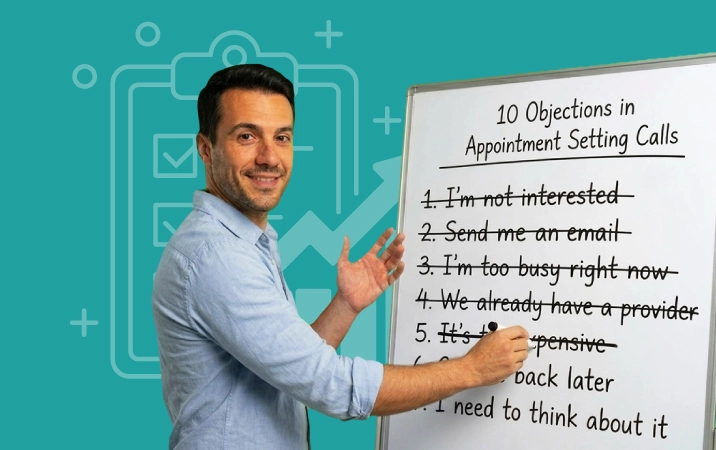
- Answer objections with a question. When a prospect already has a vendor, asking what a second opinion needs to show keeps the conversation open. Each of the common objections in appointment setting calls has a reply worth scripting in advance.
- Confirm within 24 hours. A confirmation call and email inside that window restate the time, the agenda and who will attend.
Daily reports track dials, connects, conversations, appointments set and appointments held, and a script that stops converting gets revised the same day. Nothing waits for a monthly review. Underperforming list segments get retargeted within the week.
Do telemarketing rules apply to B2B appointment setting calls?
The federal Telemarketing Sales Rule reaches B2B appointment setting calls in one respect: since 2024, it bars misrepresentations and false or misleading statements. Genuine B2B calls skip the rest.
The exemption sits at 16 CFR § 310.6(b)(7), and it does not cover calls selling nondurable office or cleaning supplies. Its proviso keeps the bans in § 310.3 on misrepresenting material facts and on false or misleading statements in force for business calls. That proviso took effect in May 2024.
The final rule published in the Federal Register carries the FTC’s record and reasoning for the change. The Telemarketing Sales Rule explainer covers where the B2B exemption ends and how the rule overlaps with the Telephone Consumer Protection Act.
Business calls get a narrow carve-back. In plain terms, B2B calls skip the registry scrub, calling-hour limits and opening disclosures, but every claim has to be true.
The setter’s words are the exposure. An appointment-setting call is part of the campaign that sells your product, so its claims count the same as the closer’s. For a setter, material facts include what your product costs, what it does, any conditions on buying it and any claimed affiliation. Pre-2024 scripts need a fresh review.
Here is how it goes wrong. Picture a setter behind on an appointment target who opens by following up on a pricing request the prospect never made. That opener is a false statement. It also hands the closer a prospect who already distrusts the company before the appointment begins.
Review recorded calls for openers that imply a request, a referral or a relationship that does not exist. Approve every claim in the script in writing. Tie setter incentives to appointments held, which reduces the pressure to stretch the truth for an appointment set.
The federal answer is not the whole map. From mid-October 2026, Pennsylvania’s telemarketing law, amended in July, covers calls to business lines as well as homes and mobiles. Kelley Drye’s summary of the Pennsylvania amendments sets out the consent, calling-hour and registration terms that follow.
Courts now read these statutes for themselves. The Supreme Court’s Loper Bright opinion ended Chevron deference to agency readings of federal law in 2024. In 2025, its McLaughlin opinion freed district courts from the FCC’s reading of the Telephone Consumer Protection Act. Open B2B questions now get court-by-court answers. One is whether a business contact’s personal mobile counts as a residential line under the do-not-call rules.
This is operational guidance, not legal advice.
How do you judge B2B appointment setting results?
Judge B2B appointment setting on two numbers: appointment-to-opportunity rate, the share of appointments held that become pipeline opportunities, and cost per held appointment. Cost per held appointment is the program’s total cost divided by the number of appointments held.
Metric | How to calculate it | Benchmark and its conditions |
|---|---|---|
Connect rate | Dials that reach a live, relevant person ÷ total dials | 11% to 13% on outbound B2B phone campaigns dialing corporate main lines |
Appointments set | SQLs who accept a date and time with a closer, counted per block of calling hours | 20 to 30 per 160-hour block in healthcare, set by phone |
Show rate | Appointments held ÷ appointments set | 70% to 85% for phone-set B2B appointments that pass four checks and get a 24-hour call-and-email confirmation |
No-show rate | Appointments set that never take place ÷ appointments set | 15% to 30% under the same conditions as the show rate above |
Appointment-to-opportunity rate | Opportunities opened ÷ appointments held | Set from your own CRM history by deal size; no outside figure transfers between deal sizes |
Cost per held appointment | Total program cost ÷ appointments held | $207 to $377 for a healthcare 160-hour block at a 70% to 85% show rate |
One outside study anchors these numbers. The Bridge Group’s 2025 SDR models, motions and metrics report surveyed 351 B2B companies, 83% of them SaaS, with a median deal of $50,000. Its median monthly quota per SDR is 10 first appointments held, and 60% of reps reach it.
That is the in-house yardstick. A full-time SDR on a SaaS-heavy team is expected to produce ten held first appointments a month, and four in ten fall short.
The appointments-set count flatters a program. Hold any provider’s numbers to the same unit: appointments held per calling month, at your qualification standard. A provider paid per appointment set gains from loose criteria, and show rate exposes the loosening.
The failure is quiet. Picture a monthly report that leads with appointments set, while show rate slides and the CRM logs no new opportunities. The invoice looks fine; the pipeline does not.
Appointment-to-opportunity rate belongs to your closers, so log every appointment held in the CRM with its outcome. That CRM record is the evidence a renewal decision rests on, so keep it clean from week one.
Five questions to ask any provider
Ask them before you sign.
- Who sets the qualification criteria? Your closers sign off on title, budget authority, timeline and need before the first dial, and the provider holds to them.
- Do reports separate appointments set from appointments held? A provider that reports only appointments set is reporting its own activity, not your pipeline. Ask for both, every week.
- What conditions sit behind each benchmark? A show rate or connect rate means nothing without the vertical, deal size, list source and channel mix that produced it.
- Who dials your list? Dedicated setters learn your buyers, while setters shared across campaigns trade that depth for a lower hourly rate. Both models have a place.
- Where do information requests go? Prospects who ask for information instead of an appointment belong in a nurture queue, logged as leads with call notes.
What does B2B appointment setting cost?
B2B appointment setting is priced by calling hours, as a monthly program or per appointment set, and compared on cost per held appointment.
Calling-hour blocks
Hourly pricing buys calling time in blocks. A 160-hour block is one full-time setter for a month, and the appointments it produces decide your cost per appointment set. In healthcare, one 160-hour block sets 20 to 30 appointments at $176 to $264 per appointment set.
Monthly programs
Monthly programs fix the fee. One fee covers setters, dialing technology, quality assurance and management, with a one-time setup fee for list build and integration.
Pay per appointment set
Pay-per-appointment pricing charges only for appointments set. It looks safe, but it pays the provider for appointments set whether or not they are held, which rewards loose criteria. Ask how a no-show is billed, credited or rebooked before comparing any per-appointment rate quote.
Comparing the models with in-house setting
One formula compares all three. Divide total program cost by appointments held. At a 70% to 85% show rate, the healthcare 160-hour block’s $176 to $264 per appointment set becomes $207 to $377 per held appointment.
In-house setting has a fixed cost. A fully loaded in-house sales development rep in the US costs $85,000 to $130,000 a year before setting a single appointment. That range counts salary, benefits, payroll taxes, recruiting, tools and management for a full year.
An outside benchmark agrees. The Bridge Group’s 2025 study of 351 B2B companies puts median SDR on-target pay alone at $80,000, with a three-month ramp.
Model | What you pay for | Incentive it creates | Cost per held appointment | |
|---|---|---|---|---|
Calling-hour blocks | Setter time, bought in blocks; a 160-hour block is one full-time setter for a month | Paid for time, so loose criteria earn the provider nothing extra; appointments held per block is the number to watch | Block price ÷ appointments held; $207 to $377 for a healthcare 160-hour block at a 70% to 85% show rate | |
Monthly program | One fixed fee for setters, dialing technology, quality assurance and management, plus a one-time setup fee | Paid the same fee whatever the output, so appointments held per month is the number to watch | Monthly fee, plus the setup fee spread across the term, ÷ appointments held that month | |
Pay per appointment set | Each appointment set, whether or not it is held | Paid per appointment set, so looser criteria raise the provider’s revenue | Rate per appointment set ÷ show rate, unless no-shows are credited or rebooked | |
In-house SDR | A full-time hire at $85,000 to $130,000 a year, fully loaded, in the US | Your criteria and your training, with the full cost running through a three-month median ramp (Bridge Group, 351 B2B companies) | Annual fully loaded cost ÷ appointments held in the year, ramp months included |
The test is simple: set that cost per held appointment against your appointment-to-opportunity rate and average deal size. Either the program pays or it does not. Run it before you sign.
Define what an appointment set means for your team
A strategy call maps your ideal customer profile, your qualification criteria and how many appointments your closers have room for each month. Bring your current numbers.

When does scalable B2B appointment setting make sense for your team?
Scalable B2B appointment setting needs a defined ideal customer profile and closers with open calendar time. Without both, more appointments add cost, not revenue.
Volume scales in blocks of calling hours. Recurring enterprise programs of 800 hours or more push the cost of each appointment set lower than a single block does.
Volume also multiplies information requests, and each one is a lead to work rather than an appointment to keep. Who works them is its own decision. The split between appointment setting and lead generation sets out both services and the numbers each one answers to.
Scale works in both directions. Adding setters to a loose profile burns through the list faster and books appointments your closers cancel. With the profile and criteria right, the same campaign grows from one pilot block to a full program without changing shape.
Frequently asked questions
What is B2B appointment setting, and what does an appointment setter actually do?
B2B appointment setting is outbound calling that sets first sales appointments with decision-makers at companies that fit your profile. The setter dials, qualifies and schedules. Each appointment set lands on a closer’s calendar with notes on who the prospect is, what they need and why they agreed to talk.
What counts as a qualified B2B appointment before it goes on my sales team's calendar?
Four checks come first. The prospect holds a decision-making title, has budget authority, has a buying timeline and has confirmed a real need. Your sales team sets those criteria before calling starts, and a prospect who misses one does not get an appointment set.
How many appointments does a B2B appointment-setting campaign set in a month?
Volume follows calling hours. In healthcare, one 160-hour calling block sets 20 to 30 appointments a month at $176 to $264 per appointment set. Vertical, deal size and list source shift them.
What should an agent say when someone asks to be taken off the call list?
Do B2B appointment-setting calls have to follow telemarketing laws like the TSR?
A program covers the decisions an agent makes on a live call: the limits of prior express written consent, how to log a do-not-call request, how to recognize a revocation in non-standard wording, calling hours measured at the called party’s location, the required oral disclosures, caller identification on request, why the dialer is configured as it is, and accurate call dispositions. Each element should end in an assessment rather than an attendance record, because the assessment is what demonstrates the training actually happened.
How do I judge whether an appointment-setting provider is delivering results?
Track cost per held appointment. Divide what you pay by the appointments that actually took place, then check how many of those became pipeline opportunities in your CRM. A provider that reports only appointments set is reporting its own activity, not your pipeline.
Run the numbers before you commit budget
The outbound campaign ROI wizard asks short questions one at a time and explains each metric in plain language. It returns projected monthly profit for a managed program and the breakeven point for an in-house team.