
B2B appointment setting services decide which prospects reach your closer’s calendar by testing each one against qualification criteria agreed before calling starts. Write those criteria down first. List the role, budget authority, need and time frame a prospect must confirm, plus disqualifying answers, then test them against your closers’ first conversations.
In This Article
Appointment setting services report a chain of counts, and each ratio between two counts shows where appointments are lost. This guide works through every ratio. The guide to what B2B appointment setting is and how it works names the measures that judge a program.
The B2B appointment setting service page lists the counts in one provider’s daily report: dials, connects, conversations, and appointments set and held. Each benchmark here carries its conditions. Test your numbers, or any provider’s, against them.
Which KPIs should appointment setting services report, from dial to appointment held?
Appointment setting services should report five counts in order: dials, connects, conversations with the decision-maker, appointments set and appointments held. Each rate divides a count by its predecessor.
Write each rate with its denominator.
- Connect rate is the share of outbound dials that reach a live person who matches your target profile.
- A decision-maker conversation is a connect with the person who owns the problem and can accept a time.
- Set rate: appointments set per decision-maker conversation.
- An appointment set is a time the decision-maker accepts with a closer, after the setter confirms the campaign’s qualification criteria.
- An appointment held is one the decision-maker attends.
- Show rate is the share of appointments set that become appointments held, counted after reschedules settle.
- No-show rate is one minus show rate.
- Appointment-to-opportunity rate is the share of appointments held that your closers turn into a qualified pipeline opportunity.
- Cost per held appointment: total cost ÷ appointments held.
The rates multiply into a forecast. Decision-maker share is the fraction of connects that reach the person who owns the problem. Connect rate times the decision-maker share, times set rate, times show rate, gives appointments held per dial. Fix the weakest stage first. A strong set rate with a weak show rate points to qualification or confirmation, not to the list.
The outsourced appointment setting service page ends one provider’s daily report with cost per qualified appointment, read here as cost per appointment set. The table pairs each KPI with its conditions.
Its rows come from the B2B appointment setting guide’s connect-rate figures and one provider’s appointment setting service page. Survey rows cite The Bridge Group’s 2025 survey, and the abandonment row cites the FCC rule on eCFR.
KPI | How it is calculated | Published figure | Conditions behind it |
|---|---|---|---|
Connect rate | Live target-profile connects ÷ dials | 11% to 13% | Outbound B2B phone campaigns dialing corporate main lines; first-party; vertical, list source and period not published |
Dials per conversation | Dials ÷ live conversations | Eight or nine | Same main-line campaigns, first-party |
Quality conversations per day | Survey average per SDR | 4.6 on 56 dials | Phone-centric SDR teams; 351 B2B companies, 83% SaaS, online survey 2024 to 2025 |
Set rate | Appointments set ÷ decision-maker conversations | Not published | Ask each provider by vertical, list source and line type |
Show rate | Appointments held ÷ appointments set | 70% to 85% | Phone-set B2B appointments passing four checks with a 24-hour call-and-email confirmation; across client programs; vertical, deal size and list source not published |
First appointments held per SDR | Survey median monthly quota | 10, with 60% of reps at quota | Same survey; in-house SDR teams |
Cost per appointment set | Program cost ÷ appointments set | $176 to $264 | Healthcare; 160-hour blocks setting 20 to 30 appointments; deal size and list source not published |
Cost per held appointment | Program cost ÷ appointments held | $207 to $377 (derived) | $176 ÷ 0.85 and $264 ÷ 0.70; a worked example, since the show rate is not healthcare-specific |
Abandonment rate | Abandoned calls ÷ calls answered live, per campaign per 30 days | answered live, per campaign per 30 days 3% ceiling | FCC rule limit, not a performance benchmark |
Need operational compliance help, not a lawyer?
If no claim is pending, a campaign compliance audit answers whether your consent records, scrubbing and opt-out handling hold up. Each gap-report finding carries its regulatory citation, so the legal questions are easy to hand to counsel.

Ask providers for every unpublished row.
What connect rate should appointment setting services reach on B2B lists?
On outbound B2B phone campaigns dialing corporate main lines, one provider’s published connect rate is 11% to 13% of dials. Vertical and list source are unpublished.
The B2B appointment setting guide’s connect-rate benchmark equals eight or nine dials per live conversation. It names one condition: corporate main lines. Connect rate moves with four inputs a buyer can ask about: list source, line type, attempts per record and calling hours. Line type means a corporate main line, a direct dial or a mobile number the contact gave for work. Without all four, no comparison holds.
Survey data gives the daily view. The Bridge Group’s 2025 SDR metrics report surveyed 351 B2B companies online in 2024 and 2025, and 83% were SaaS. Phone-centric SDR teams in that survey averaged 56 dials and 4.6 quality conversations per rep each day. 56 ÷ 4.6 gives 12.2 dials per quality conversation. Its unit is a quality conversation as the survey defines it, not a connect from your dialer report.
Put plainly: twelve dials buy one real conversation, before the decision-maker has agreed to anything.
Read connect rate per dial, not per hour. For your plan, dials per conversation sets how many calling hours each appointment set costs you. A plan built on eight dials per conversation, run against a list that needs twelve, falls a third short before any objection.
Measure your own ratio in week one. Then plan calling hours from your own number, not from any published benchmark or survey average. A dialer that places more calls per agent hour raises connects per hour without raising connect rate, and the speed carries a compliance cost.
Can dialing faster to raise connect rates put an appointment setting campaign out of TCPA compliance?
Dialing faster puts an appointment setting campaign out of TCPA compliance once its dialer abandons calls. The FCC’s abandonment rule caps abandoned calls at 3% of calls answered live by a person, measured per campaign over 30 days.
The rule’s test is two seconds. Under the FCC’s call abandonment rule, 47 CFR 64.1200(a)(7), on eCFR, a call is abandoned when no live representative picks up within that window. The clock starts at the person’s completed greeting. Abandonment rate is the share of calls answered live that no representative picks up within those two seconds. A recorded message must then name the business, say the call was telemarketing and offer an opt-out. The seller keeps records proving compliance.
Put simply: if no setter is on the line in two seconds, the call counts against you.
The rule’s text has no residential limit. On its face, it reaches business lines and the mobile numbers decision-makers give for work. The guide to building a compliant autodialer campaign adds that the Telemarketing Sales Rule’s business-to-business exemption does not reach the FCC’s rules. So abandonment rate belongs on your report. It is the price of a connect rate pushed up by dialer pacing faster than setters can answer.
Picture a monthly report where connect rate climbs two points after a dialer change, with no abandonment line. The closers see more appointments set. Nobody sees the calls dropped in silence, and nobody kept the records the rule requires.
The rule is not settled. The FCC has proposed eliminating the 3% cap and the minimum ring time, as TCPAWorld’s report on the FCC proposal describes. A proposal changes nothing on its own.
The safeguards fit on one contract page. Report abandonment rate per campaign for each 30-day period beside connect rate, and name the dialer mode. Configure the recorded identification and opt-out message on the dialer before the campaign’s first dial. Keep the records the rule requires.
Since the Supreme Court’s June 2025 McLaughlin Chiropractic v. McKesson opinion, district courts in TCPA suits are no longer bound by the FCC’s reading. Each court reads the rule’s text itself. Pennsylvania’s amended telemarketing law, in force since 18 October 2026, allows solicitations only from 9 a.m. to 7 p.m. and none on Sundays. Whether it reaches business lines is open. Calling hours are one of the four connect-rate inputs, so a state window can move your benchmark.
This section describes the rule’s text for planning, not legal advice; have counsel confirm how it applies to your lists.
How do appointment setting services measure set rate, and what moves it?
Set rate is appointments set divided by decision-maker conversations, and appointment setting services should report it per conversation and per 100 dials. Check the qualification standard first when it moves.
Qualification work sets the ceiling on set rate. The B2B lead qualification service page describes qualification sold on its own: callers verify budget, confirm authority, assess need and gauge timeline.
One provider’s pages publish no B2B set rate. So this guide teaches the arithmetic: appointments set per 100 dials equal 100 times connect rate, times decision-maker share, times set rate. Report every stage separately. A count per 100 dials that skips the stages in between hides which of them moved, and which stayed flat.
Qualification strictness is set before dialing. IBM’s BANT criteria template defines a qualified opportunity by budget, authority, need and timeframe, and it rejects incomplete records.
Put plainly: BANT asks who pays, who signs, what the problem is, and when it gets fixed.
Every required element costs you appointments. The guide to defining qualification criteria for an appointment setting campaign draws the line: require budget authority, not an approved budget. A program that demands an approved budget sets fewer appointments and loses decision-makers whose budget cycle opens next quarter.
Judge strictness by cost per held appointment. Survey quotas show the same pattern. The Bridge Group’s 2025 survey puts the median at 16 first appointments held a month for introductory-stage SDRs, against 9 for fully qualified.
What show rate should I expect from an outsourced appointment setting service, and what raises it?
Expect 70% to 85% from an outsourced appointment setting service, the range one provider’s service page reports with four checks and 24-hour confirmation. Vertical, deal size and list source are unpublished.
That range covers phone-set B2B appointments across one provider’s client programs, as its appointment setting service page reports. Checks: title, budget authority, timeline, need. Ask any provider for the vertical, deal size and list source behind its range before comparing it with yours. Count show rate after reschedules settle, or a moved appointment reads as a no-show in the weekly report.
A closer feels the no-show rate. Three inputs raise show rate, in the order a program controls them: the time-frame criterion, the confirmation and the closer’s context. A firm time frame gives the prospect a reason to show up for the closer on the agreed day. When show rate falls, check time frame first. Then check the 24-hour confirmation sequence, and the notes the closer received before the appointment started.
How do you turn appointment setting services KPIs into cost per held appointment?
Divide total program cost by appointments held to turn appointment setting services KPIs into cost per held appointment. That one figure sets the results of appointment setting managed services against deal size and close rate.
Work it from one provider’s published healthcare case. Its B2B appointment setting service page gives 160-hour blocks that set 20 to 30 appointments, at $176 to $264 per appointment set. At that page’s 70% to 85% show rate, cost per held appointment runs from $207 to $377. The arithmetic: $176 ÷ 0.85 and $264 ÷ 0.70. Deal size and list source are not published for the case, and the show rate is not healthcare-specific. Treat the range as a worked example.
Run the same division on an in-house team. The Bridge Group’s 2025 survey of 351 B2B companies, 83% SaaS, puts the median SDR quota at 10 first appointments held a month. Only 60% of reps reach it. Divide fully loaded monthly SDR cost, calling tools included, by the appointments your reps hold that month.
Is a guaranteed appointment setting service worth it, or is the guarantee a red flag?
A guaranteed appointment setting service is worth exactly what its guarantee counts, and no more than that. Counting appointments held shares no-show risk.
Counting appointments set alone pays for volume. Four terms make a guarantee realistic, and each one closes a gap a provider can otherwise exploit.
- The unit is appointments held, not appointments set.
- The count follows your written qualification criteria, not the criteria the provider applies on its own calls.
- A no-show earns a replacement appointment.
- The measurement window is fixed in the contract, so a slow first month never resets the clock.
The red flags are the reverse. Watch for a count with no definition, no qualification standard in the contract, or payment per appointment set with no show-rate floor. One provider’s service page argues that pay-per-appointment pricing rewards loose qualification, and it prices in 160-hour blocks instead. Whatever the model, check month one. The first month’s show rate tells you whether the guarantee counts the right thing for your closers.
What should an appointment setting service report every week?
An appointment setting service should report every stage with its numerator and denominator each week. Add abandonment rate and cost per held appointment.
Ask every provider, including this guide’s publisher:
- Which conditions sit behind each benchmark you quote: vertical, list source, line type and calling period?
- Do reports separate appointments set from appointments held?
- What abandonment rate did our campaign run in each 30-day period, and on which dialer mode?
- What does the guarantee count?
- What is our cost per held appointment once every fee, setup charge and data cost is included?
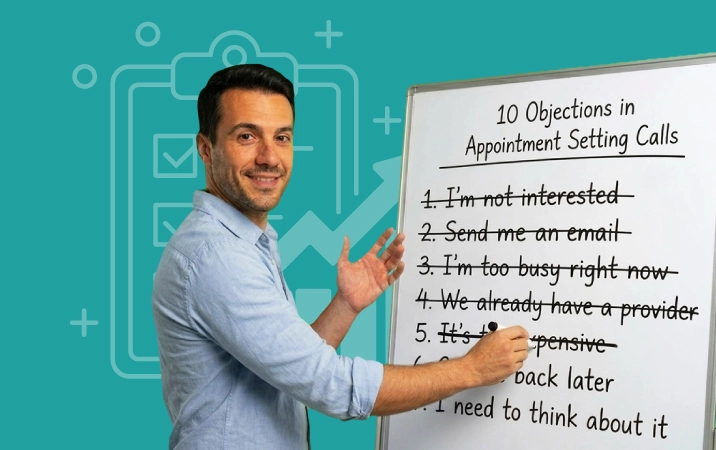
Objection-to-appointment-set rate belongs to the guide to handling the top 10 objections in appointment setting calls.
Frequently asked questions
What are good connect rate, set rate and show rate benchmarks for B2B appointment setting services?
One provider’s published benchmarks for B2B appointment setting services put connect rate at 11% to 13% of dials on corporate main lines. Vertical and list source are unpublished. Show rate runs 70% to 85% on phone-set appointments that pass four checks and a 24-hour confirmation. That provider publishes no set rate. Ask each provider for one by vertical and list source, then judge all three rates through cost per held appointment.
How many dials does an appointment setting service need to set one B2B appointment?
Dials per appointment set equal dials per decision-maker conversation divided by the set rate for that list. One provider publishes eight or nine dials per live conversation on B2B corporate main lines. Survey data runs higher. The Bridge Group’s 2025 survey finds 12.2 dials per quality conversation on phone-centric SDR teams. At an illustrative one-in-ten set rate, nine dials per conversation means 90 dials per appointment set. That assumes every conversation reaches the decision-maker.
What show rate should I expect from an outsourced appointment setting service, and what raises it?
Expect 70% to 85% from an outsourced appointment setting service when appointments pass four checks and a 24-hour confirmation. That is one provider’s published range. Vertical, deal size and list source behind it are unpublished, so ask for them before comparing. Three inputs raise show rate: a firm time-frame criterion, the 24-hour confirmation and context for the closer. When it falls, check time frame first.
Is a guaranteed appointment setting service worth it, or is the guarantee a red flag?
A guaranteed appointment setting service is worth it when the guarantee counts appointments held at your written qualification standard. It should also replace no-shows. A guarantee on appointments set alone pays for volume and leaves the no-show risk with your closers. Payment per appointment set with no show-rate floor is the clearest red flag in any contract. Check month one’s show rate.
Can dialing faster to raise connect rates put an appointment setting campaign out of TCPA compliance?
Dialing faster puts an appointment setting campaign out of TCPA compliance when its dialer abandons too many calls. The FCC caps abandonment at 3%. That cap applies to calls answered live, per campaign and per 30-day period, with a two-second window. The rule text has no residential limit. Report abandonment rate next to connect rate, and keep the records the rule requires for every campaign.
Bring your last 90 days of appointment setting numbers to a strategy call
Bring 90 days of dials, connects, appointments set and appointments held to a strategy call. You leave with your cost per held appointment, worked out in a form you can use with any provider.